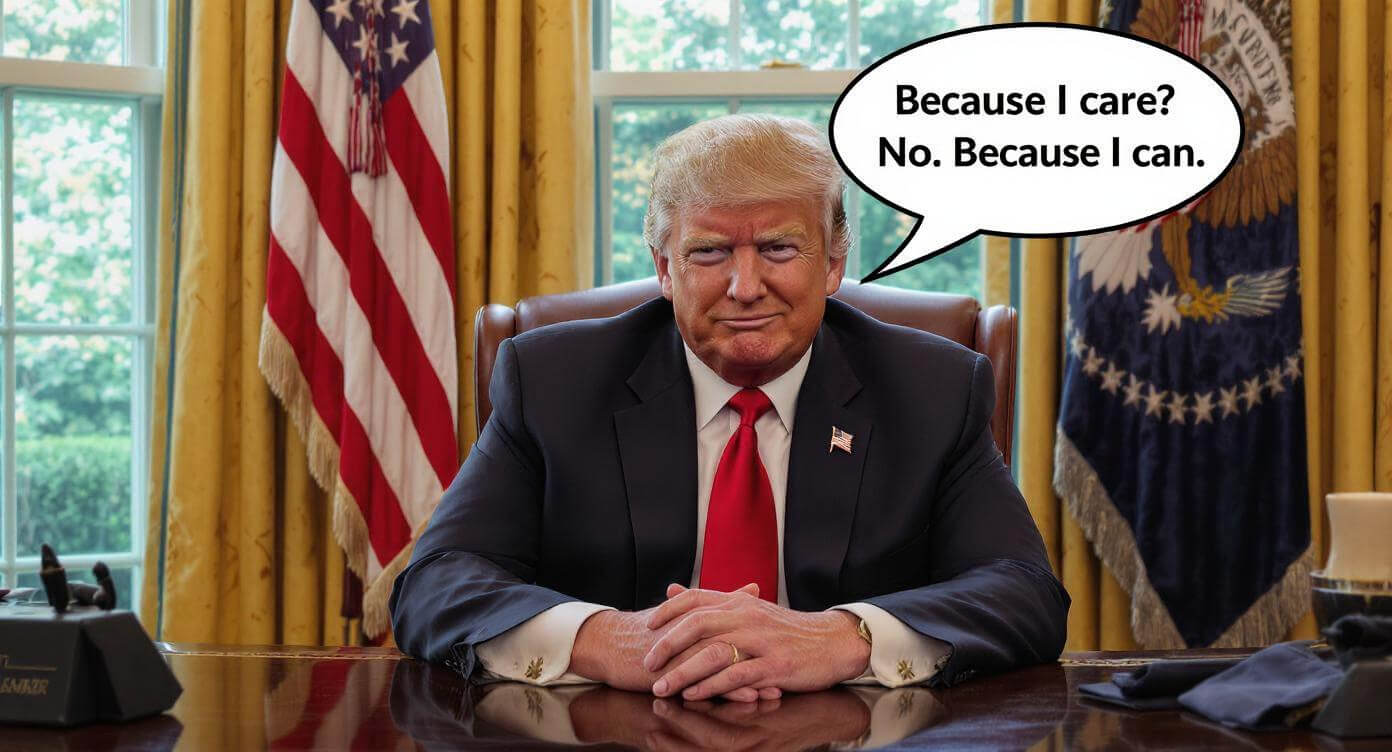

Imagine a child in a schoolyard. He’s larger than the other kids, not because of age or maturity, but because of chance. He uses his size not to protect the vulnerable but to dominate the weak. He pushes kids into lockers, mocks those who are different, and finds amusement in fear. He isn’t held accountable, perhaps because adults are afraid, or because his family donates to the school board. Now imagine that same child never grows up emotionally, but is handed a fortune and, eventually, the most powerful political office in the world.
This metaphor begins to capture the phenomenon of Donald J. Trump.
Trump didn’t emerge from obscurity through struggle or self-sacrifice. He inherited an estimated $400 million from his father—a vast reservoir of economic power and privilege. But economic power isn’t enough. Trump craves the theatrical, the symbolic, the ultimate form of control: political power. Now that he holds the presidency again, he isn’t just handed the keys to the White House—he is granted command over the executive branch of the U.S. government, global diplomatic channels, command over the military and the national guard, and the nuclear codes.
Rather than seeing this immense power as a burden of responsibility—an opportunity to serve the public, protect the vulnerable, or lead with vision—Trump appears to see it as a personal privilege. A new kind of supremacy to satisfy an insatiable ego.
His actions seem driven less by strategy or policy than by impulse and the need for domination. He rules not with empathy, but with vengeance. Whether through cruel immigration policies that rip families apart, attempts to strip healthcare from millions, or public ridicule of marginalized communities, Trump appears to take pleasure in using his power to hurt others. There is no visible struggle between empathy and ego. If anything, his administration treats compassion as a liability—a weakness to be eradicated.
The psychological profile that emerges is more than narcissistic—it hints at sadism. Like the archetypal child with a magnifying glass on a sunny day, gleefully burning ants just to see what happens, Trump seems to experiment with policy in ways that disregard human cost. The pain he inflicts is not a side effect—it is the point. The spectacle of suffering reinforces his power.
Tariffs aren’t just economic tools; they are weapons to wield against foreign governments and domestic dissenters alike. Legal protections for minorities, immigrants, and LGBTQ+ people are not merely neglected—they are intentionally eroded, as if their vulnerability proves his might. Public health guidance is mocked. Refugees are dehumanized. Political rivals are demonized.
This is not what leadership looks like in a mature democracy. It’s what happens when emotional immaturity, unchecked privilege, and raw political power combine in one individual. It is governance by tantrum—national policy shaped by impulse, insecurity, and cruelty.
When a 13-year-old bully is given a billion dollars and the power of the presidency, we see reckless cruelty, a hunger for attention, and decisions made without regard for long-term consequences or moral accountability. In Trump’s case, that expectation is not hypothetical. It plays out in real time—with real-world consequences for millions.
This forces us to confront uncomfortable questions about the nature of power in a democracy: What kind of person seeks it? What kind of system allows it? And what happens when the most powerful office in the world is reduced to a personal vanity project?
Trump’s return is not simply a failure of character—it is a failure of collective vigilance. And if citizens of the USA are to prevent another schoolyard tyrant from ascending to such heights, you must demand not just competence from your leaders, but conscience.



0 Comments