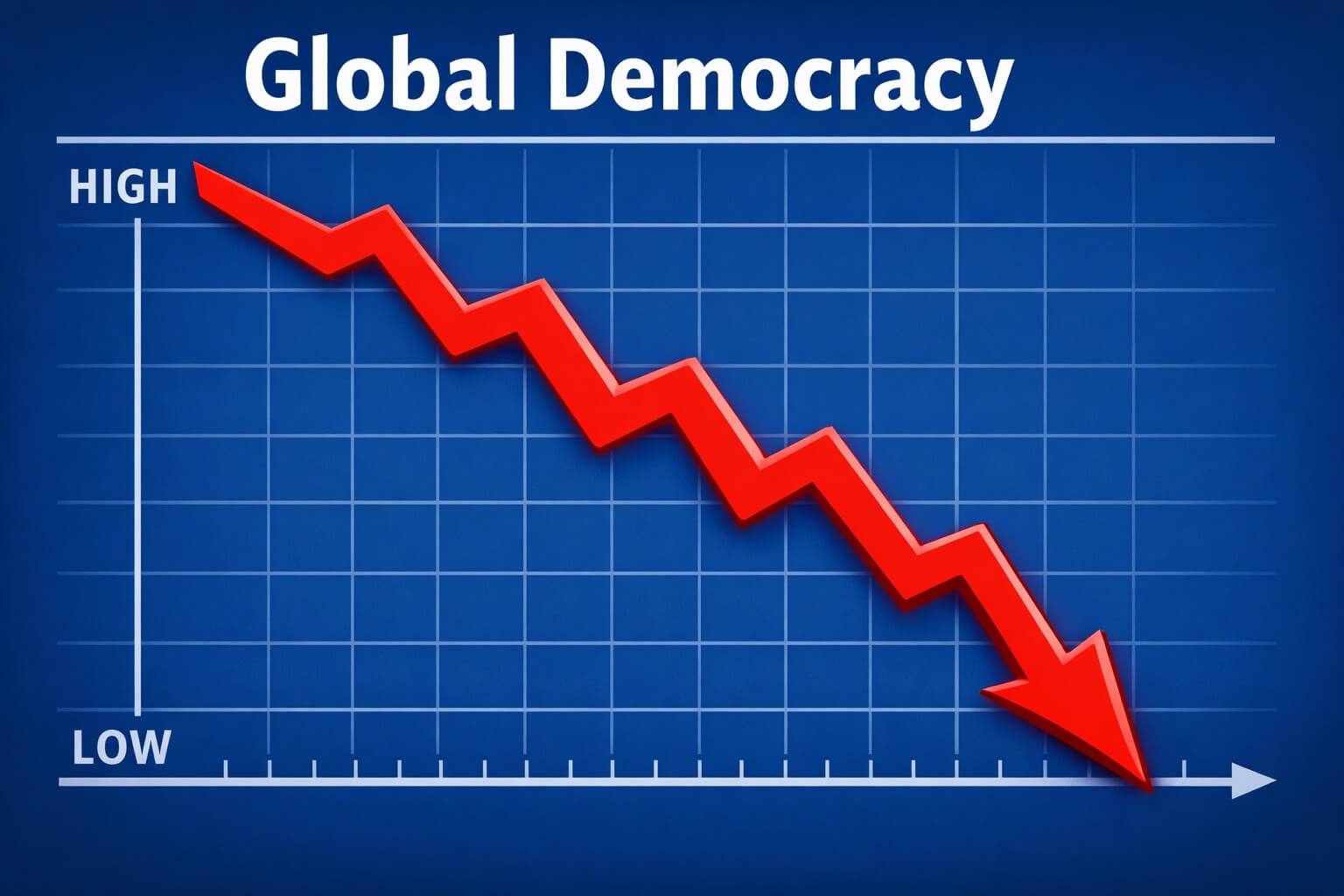

In his recent article “We must not underestimate the peril for democracy,” Financial Times columnist Martin Wolf has issued a stark warning about the global state of democracy. Drawing on recent international research and comparative political data, he argues that democratic institutions are not simply under pressure — they are entering a period of accelerated decline. In his view, the most troubling development is that the United States, long seen as a central pillar of democratic leadership, is now itself contributing to this downward trend.
Key points raised in Wolf’s analysis include:
-
Two major global studies — one by Sweden-based V-Dem and another by Freedom House — suggest the world is moving from a prolonged “democratic recession” toward what may become a full-scale democratic depression.
-
Freedom House reports that 2025 marked the twentieth consecutive year of declining global freedom, with significantly more countries losing political rights and civil liberties than gaining them.
-
V-Dem’s data shows a dramatic shift in the balance of governance worldwide: the share of the global population living under autocratic systems has risen sharply, while the proportion living in fully functioning liberal democracies has fallen to historically low levels.
-
Restrictions on freedom of expression are spreading rapidly across many countries, and some indicators point to growing reliance on repression and coercive state practices.
-
Wolf highlights the United States as a particularly significant case, arguing that its democratic institutions are weakening at a pace rarely seen in major established democracies.
-
Legislative and constitutional constraints on executive power are described as having eroded substantially, while civil rights protections are assessed as having fallen back toward mid-20th-century levels.
-
Although formal elections continue to take place, broader democratic norms — including equality before the law and robust rule-of-law traditions — are portrayed as increasingly fragile.
-
Allegations of corruption and the use of public office for private advantage are cited as contributing factors to democratic decline.
-
Comparative political analysis suggests the speed of institutional deterioration in the United States has exceeded early stages of democratic erosion previously observed in countries such as Hungary, Turkey, India, and Russia.
-
Wolf notes that leaders who accumulate power often seek to influence electoral outcomes in order to secure their position, making democratic renewal difficult once institutional safeguards are weakened.
-
Historically, democracy has been the exception rather than the rule, particularly among large global powers. The expansion of democratic norms in the late twentieth century depended heavily on both the influence and the example of the United States.
-
While American geopolitical power remains considerable, Wolf argues that its moral authority as a democratic model has been significantly diminished in the eyes of the world.
-
Divisions within Europe and the limited capacity of other democratic states are identified as obstacles to mounting an effective global defence of democratic values.
-
Despite the gravity of these developments, Wolf concludes that the fundamental ideals of democracy — popular sovereignty, free expression, rule of law, and limits on absolute power — still command deep loyalty and remain worth defending, even as they face renewed and serious danger.
As Financial Times commentator Martin Wolf warns of accelerating democratic decline globally, Canadians should not assume that our own institutions are immune to pressure. One study reports that only 7% of the global population live in a true “liberal democracy.” Canada still ranks among the world’s strongest democracies according to international monitoring groups, but several also point to a gradual erosion in democratic quality over the past decade. That is not a crisis — yet — but it is a signal.
At a time when political instability and authoritarian impulses are reshaping the global landscape, Canada’s sovereignty, public institutions, and civic culture require vigilance and active defence. Canadians must be prepared to resist political, economic, and cultural incursions that could weaken our democratic independence or draw us into the orbit of destabilizing forces beyond our borders.
One practical step is to speak up. We encourage readers to take action by commenting on our articles, using our response form at https://standingwithcanada.ca/getinvolved/ and by becoming part of a growing network of citizens committed to protecting Canada’s democratic future.



0 Comments