

Creating resilience by separating the facts from the fiction
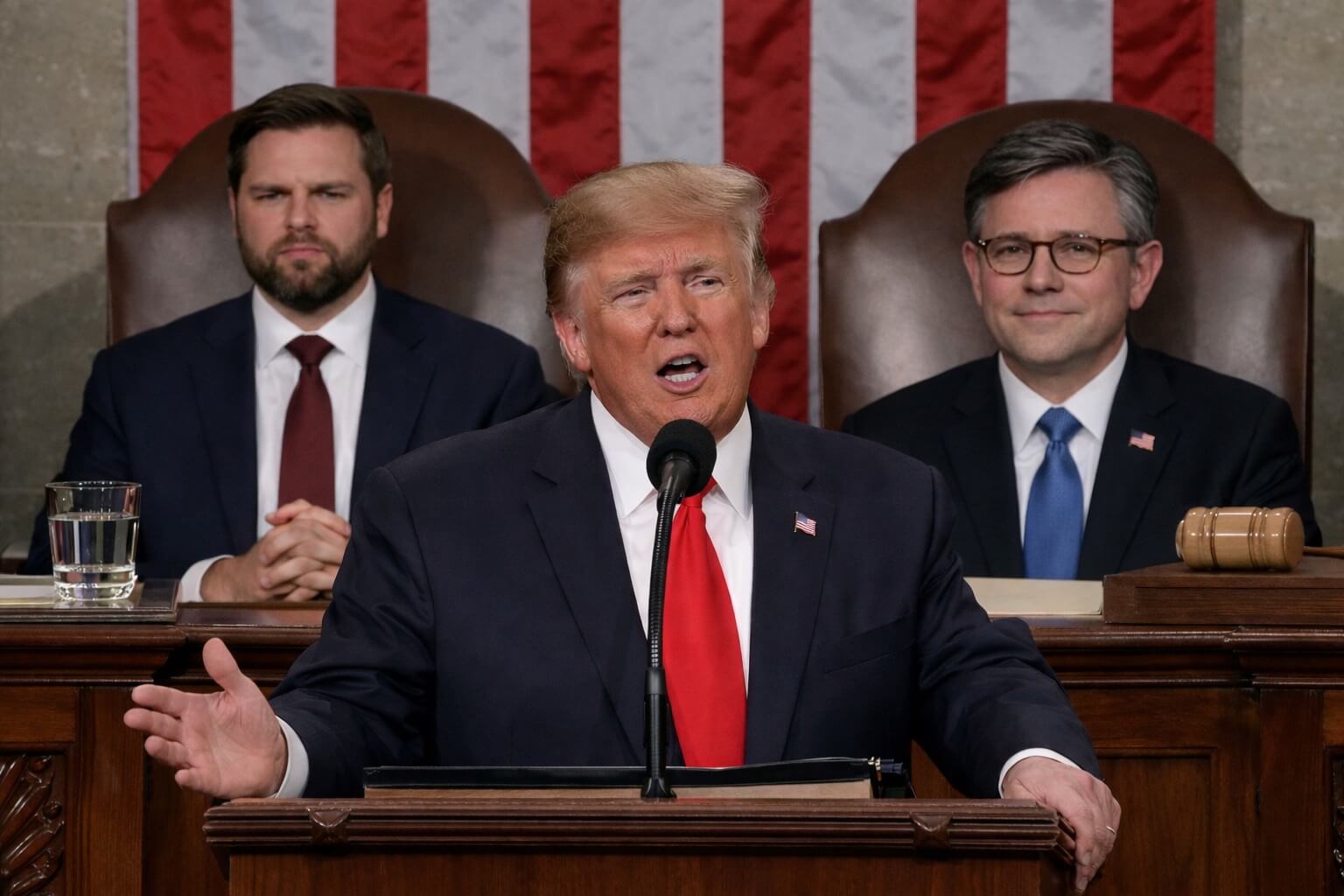
When the President of the United States delivers a State of the Union address, the speech is not merely a domestic political ritual. It is a strategic communication event watched by markets, military planners, multinational corporations, and allied governments around the world. For Canadians, it is particularly consequential. Our economies are deeply integrated; our energy grids are linked; our defence architecture is intertwined through NORAD; and our political discourse is constantly influenced by American media ecosystems. When misinformation is amplified at that level, it does not stop at the 49th parallel.
Separating fact from fiction in a U.S. presidential address is therefore not an exercise in partisan nit-picking. It is an act of civic responsibility. False or misleading claims about trade balances, border security, military commitments, climate policy, or economic performance can shape public opinion in ways that justify tariffs, weaken alliances, normalize authoritarian rhetoric, or distort democratic norms. Canadians cannot afford to passively absorb those narratives through social media feeds and cable news clips without scrutiny. A resilient Canada requires an informed citizenry that understands both the substance and the implications of what is being said in Washington.
Disinformation does not only operate through overt lies; it also works through exaggeration, selective statistics, decontextualized data, and emotionally charged framing. When repeated often enough, these distortions can create a parallel political reality—one that influences cross-border policy decisions and seeps into Canadian debates. We have already witnessed how U.S. political rhetoric can embolden extremist movements, disrupt trade relationships, and destabilize cooperative frameworks that Canada depends on for prosperity and security.
That is why rigorous fact-checking matters. It is a form of democratic hygiene. By methodically examining each claim against verified data, primary sources, and independent reporting, we reduce the power of spectacle and restore the primacy of evidence. For Canadians, staying informed about unfolding events south of the border is not optional; it is essential to protecting our sovereignty, economic stability, and democratic institutions.
Below, I present 20 false or misleading statements from the recent State of the Union address, along with clear documentation and context. The purpose is not outrage for its own sake. It is clarity. In an era where political narratives travel instantly across borders, our best defence is critical thinking, reliable information, and the collective resolve to ground public debate in demonstrable fact.
FALSE
- “In the past nine months, zero illegal aliens have been admitted to the United States.”
Verdict: False.
Why: Border encounters and attempted crossings have fallen sharply, but they were not zero; data still shows thousands of encounters and it’s impossible to prove “zero” undetected entries. (ABC News) - “I inherited a stagnant economy” / “inflation at record levels.”
Verdict: False.
Why: Real GDP growth under Biden was positive (not “stagnant”), and inflation was around 3% when Trump took office—well below the post-pandemic peak (about 9.1% in 2022). (FactCheck.org) - “Tariffs paid for by foreign countries will… substantially replace… income tax.”
Verdict: False.
Why: Tariffs are largely borne by importers/consumers and, even after increases, remain a small share of federal revenue; they are nowhere near large enough to replace income/payroll taxes. (AP News) - “I took prescription drugs… from the highest price… to the lowest.”
Verdict: False.
Why: There’s no evidence of a broad U.S. drop to “lowest in the world.” The administration’s deals and cash-price website affect limited drugs/situations, while list prices for many brand-name drugs have continued rising. (AP News) - “Price differences of 300, 400, 500, 600% and more” (on drug prices).
Verdict: False (mathematically).
Why: A 100% price cut means $0; cuts of 300%+ are not a coherent way to describe price reductions. Fact-checkers note this is mathematical hyperbole rather than a factual claim about discounts. (AP News) - “With the great big beautiful bill… no tax on Social Security.”
Verdict: False (as stated).
Why: Not all beneficiaries qualify; provisions have eligibility limits and phaseouts, and some seniors already owe no tax while others remain taxable depending on income and circumstances. (AP News) - “The cheating is rampant in our elections.”
Verdict: False.
Why: Repeated reviews and investigations have not found “rampant” fraud; documented noncitizen voting and voter impersonation are rare, and sweeping claims lack evidence. (AP News)
EXAGGERATED
- “Inflation is plummeting.”
Verdict: Exaggerated.
Why: Inflation has eased (e.g., around 2.4% year-over-year in recent readings), but “plummeting” overstates what is a moderation, not a collapse; many prices remain elevated even when inflation cools. (PolitiFact) - “Gasoline is now below $2.30 a gallon in most states… in some places, $1.99.”
Verdict: Exaggerated / partly wrong framing.
Why: A few stations may hit $1.99, but statewide averages generally aren’t below $2.30 “in most states,” according to the fact-check cited by PolitiFact. (PolitiFact) - “My first 10 months I ended eight wars.”
Verdict: Highly exaggerated.
Why: Fact-checkers note he claims credit for ending multiple conflicts where the causal link is unclear, indirect, or in some cases described as not fitting the description of an actual “war” to begin with. (AP News) - “Tariff revenues are saving our country, the kind of money we’re taking in.”
Verdict: Exaggerated.
Why: Tariffs can raise substantial revenue, but fact-checks emphasize they are far too small to offset major deficit drivers or fully fund large policy promises, and they don’t automatically translate into broad fiscal “salvation.” (AP News) - “Incomes are rising fast… like never before.”
Verdict: Exaggerated.
Why: Measures of real, after-tax income growth in 2025 were modest; describing it as uniquely rapid overstates the data compared with recent years. (AP News)
MISLEADING
- “I secured commitments for more than $18 trillion pouring in from all over the globe.”
Verdict: Misleading (unsupported and inflated).
Why: The White House’s own public tally is roughly about half that level, and analysts note these “commitments” often include long-horizon or loosely defined figures that may not equate to realized investment. (ABC News) - “Our policies are rapidly ending [high prices]… those prices are plummeting downward.”
Verdict: Misleading.
Why: Inflation cooling means prices are rising more slowly, not broadly falling; many categories are still increasing, and “plummeting” confuses rate-of-change with the price level people pay. (FactCheck.org) - “Last year, the murder rate saw its single largest decline… the lowest number in over 125 years.”
Verdict: Misleading.
Why: A large drop is plausible (and in some datasets expected), but the “lowest in 125 years” claim is not settled until complete national data is finalized; also, crime declines began before his term, so attributing it as a sharp reversal from a uniquely bad inheritance is misleading. (AP News) - “We will always allow people to come in legally…”
Verdict: Misleading by omission.
Why: Fact-checks note his administration has also tightened pathways (including refugee policy choices), so the rhetoric implies openness that conflicts with restrictive actions and narrow carveouts. (AP News) - “In many cases… drug lords, murderers… They’re blocking the removal…” (re: migrants/sanctuary jurisdictions).
Verdict: Misleading.
Why: Detention and enforcement statistics show a large share of people in DHS custody are not convicted criminals; portraying the typical case as “drug lords” and “murderers” distorts the composition of detainees. (ABC News) - “With modest additional contributions… [Trump accounts] could grow to over $100,000… by the time they turn 18.”
Verdict: Misleading (implies plausibility as typical).
Why: That outcome would require unusually high contributions and/or exceptionally high sustained returns; standard calculator scenarios don’t get close for typical households over 18 years. (PolitiFact) - “$1,776 ‘warrior dividend’ bonus checks… came from tariff revenue.”
Verdict: Misleading.
Why: FactCheck reports the funding was a reallocation from money set aside for a housing-allowance increase, not a direct, dedicated “tariff revenue” stream. (FactCheck.org) - Claiming a major “renewal” of religion in America.
Verdict: Misleading.
Why: Recent polling trends run the other direction (continued secularization), so presenting a broad national religious resurgence as a verified fact overstates or contradicts the data. (FactCheck.org)





You wrote eloquently: “Disinformation does not only operate through overt lies; it also works through exaggeration, selective statistics, decontextualized data, and emotionally charged framing. When repeated often enough, these distortions can create a parallel political reality—one that influences cross-border policy decisions and seeps into Canadian debates.”
I find myself wondering whether you are following “influencers” and websites in Canada that spread disinformation? If not, have you considered doing so in order to post countervailing facts, contextualization, and fresh information?
Personally, I do challenge SOME posts and videos on Facebook, Youtube or blogging sites that I come across that are spreading misinformation. I say SOME because I am cautious to not respond to videos and posts that are produced by bot-farms or that are clearly propaganda with a homogenous following. Leaving a comment, even a critical one, actually boosts their SEO ranking and causes them to rank higher and get more views. In other words, any comment only reinforces their “echo chamber.” So I only leave a comment if the video or post contains genuine content and seems to be engaging a variety of comments and responses.