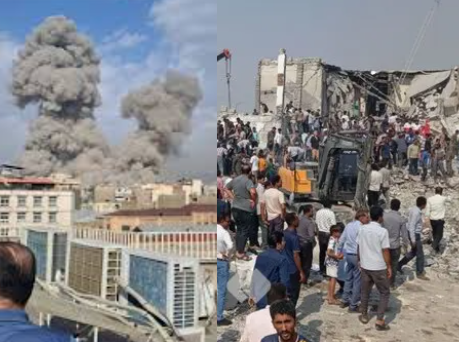

By my values at least, one of the most appalling aspects of the February 28, 2026 bombing of the Shajareh Tayyebeh girls’ elementary school in Minab, southern Iran was the relative silence from Canadian and most American media on this tragic act.
According to the most recent local reports, between 165 and 180 people were killed and 95 to 96 people were injured in that airstrike. The majority of those victims were young schoolgirls between 7 and 12 years of age. At this point, there have been no official reports on whether that inhuman carnage was inflicted by an American or Israeli warplane.
Some first-responders are reported to have claimed that two bombs were dropped, with the second bomb killing survivors of the first who were being brought to a nearby prayer hall. If true, that would constitute “double-tapping”, a terrorist tactic often considered a war crime, whereby a second strike is launched minutes after the first to target emergency responders and survivors, thereby maximizing casualties. It’s hard to imagine that the employment of such a tactic could ever be construed as have been in any way accidental.
Were this tragedy to have been the result of an earthquake or even an attack by a terrorist or deranged individual, the media would have been all over it. But this wasn’t actually an act of war because it was ordered by the President of the United States where, constitutionally, declarations of war can only be made by made by Congress. Even had Congress been consulted and agreed, it would still have been a gross violation of longstanding international law because the UN Security Council had neither been consulted nor agreed. And if it wasn’t an act of war, then logically it could only have been an act of mass murder (of children, no less).
In this situation, the decision to use military force against Iran was made by a single individual. The reasons given for that action have been inconsistent and remain unclear. Those in the chain of command who carried out the orders are shielded by their duty to follow instructions, even though the legality of those orders is in question. For that reason, the responsibility for the resulting deaths rests primarily with Donald Trump. In practice, however, it is unlikely that he will ever face consequences.
Unsurprisingly, the White House Press Secretary, Karoline Leavitt, explicitly rejected any US Government accountability, saying “I would just tell you very strongly; the United States of America does not target civilians, unlike the rogue Iranian regime”. So who did target those civilian children? Was it a rogue American president (rather than the United States of America which wasn’t legally engaged in a war) or was it his Israeli equivalent, and why won’t either country say which? The simplest explanation is that continuing the ambiguity serves their mutual interest in avoiding due accountability.
We only know for certain who isn’t responsible – those now-deceased schoolchildren whose lives were sacrificed to whatever self-serving political games the decision-making leaders were playing when they chose to launch that illegal surprise attack. It’s truly disheartening that our media, rather than pursuing the truth and seeking accountability the way they would have 20 or even 10 years ago, are either content to or sufficiently cowed that they will go along with the authorities preferred “nothing to see here; move along folks” pressure.
To be worthwhile human beings, it’s important that we see the victims of despicable criminal acts as real people who had just as much right as us to live their lives free from random violence. That’s especially true of children, who we are morally bound to protect regardless of race, nationality or location. That essential moral aspect is largely missing from the North American media reporting which I have thus far seen. If you wish to see (and can cope with seeing) some of those very real victims, a partial list with names, ages and photos has been published by the Middle East Eye, a left-leaning London-based, digital-native news organization launched in 2014, focusing on the Middle East and North Africa.




You are right. We consumers of Western media outlets have been allowed to flicker our eyes briefly over the warmongers’ atrocities in Iran, as we scroll through our news feeds. There is no better example than the one you gave of the bombing of schoolchildren.
I clicked on the link you offered of the partial list posted by Middle East Eye, along with some of the pictures of the sweet-faced children. In an effort to honor each one in the only way immediately available to me, I read aloud each name, along with their ages. By the tenth name, I was in tears and remained in tears, pulling tissues from a box beside me, as I made my way through the 61st name. I came to realize that the same family name was possessed by multiple children, meaning that it is possible that entire families were wiped out. There was a 2 month old baby with the family name Zarei, and a 9 and 10 year old with that name. I am guessing the mother of those children was one of the 8 women killed, who were likely teachers aged late twenties to early 40s. The children were almost always very young–ages 6 to 10.
The other massacre that should be filling our hearts with horror is the blowing up of an Iranian ship off the shore of Sri Lanka. It was returning from a peacetime exercise to which it was invited by India. It was obviously no threat to the US or Israel in that location. The U.S. left it to Sri Lankan authorities to fish 87 dead bodies from the water, with another 80 believed to be missing, and to tend to 32 survivors. Does anyone serving on that US submarine feel proud of attacking a ship that posed no threat? I’m at a loss for further words.