
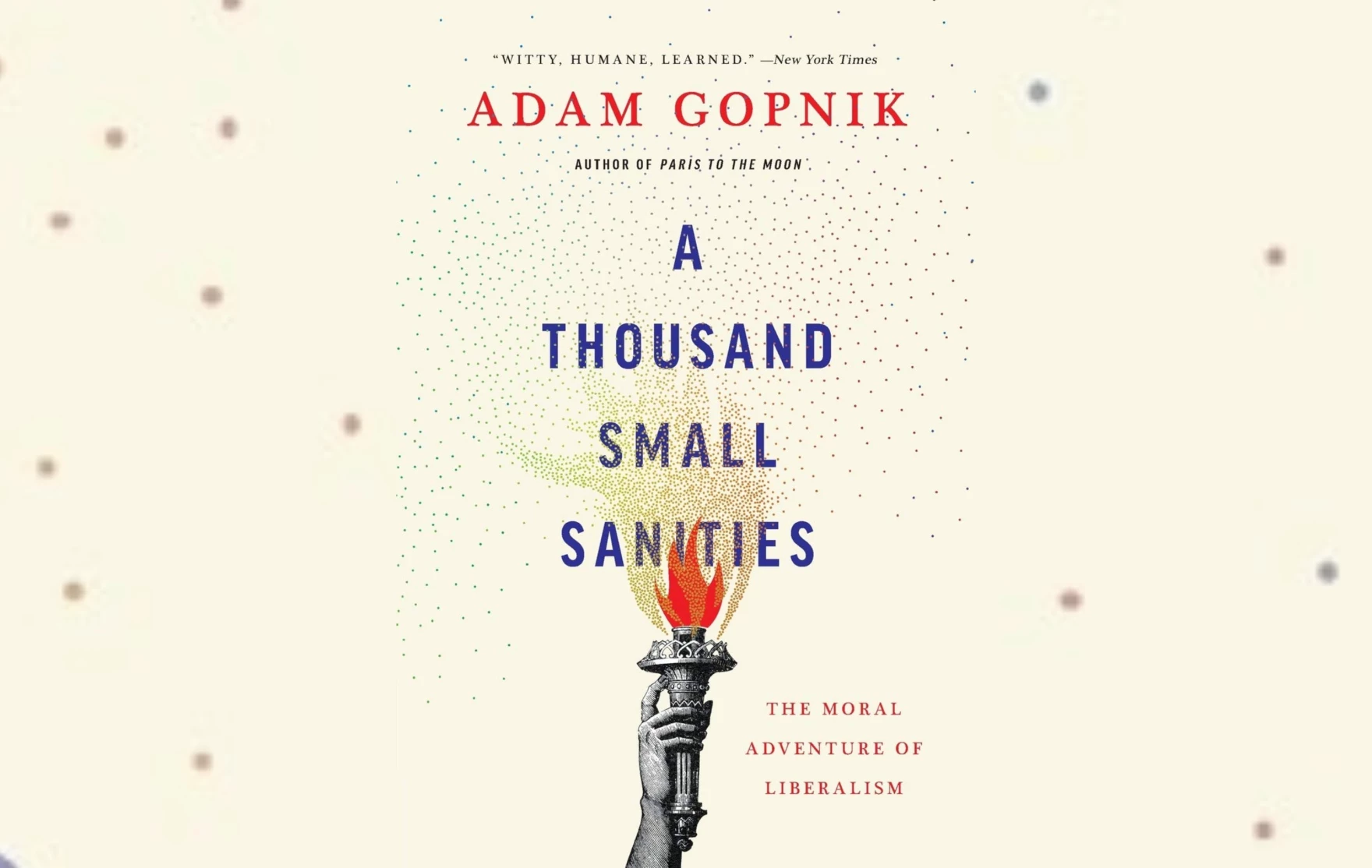

I recently read A Thousand Small Sanities by Adam Gopnik, and it struck me not just as an eloquent defense of liberalism but as a reminder of what is most precious about the country I call home—Canada. In this compact yet profound book, Gopnik does not treat liberalism as a partisan label or an economic policy preference. Instead, he describes it as a broad moral and social philosophy grounded in reason, empathy, pluralism, and incremental reform.
Liberalism, for Gopnik, not about openness and compromise for its own sake. It is about a steady, hopeful faith in the possibility of improvement through dialogue, evidence-based reform, and the protection of human dignity and freedom. It is a way of thinking that values institutions, dissent, and complexity over dogma, absolutism, and purity.
Reading Gopnik, I was struck by how closely his vision of liberalism aligns with the values that have shaped Canada: a belief in pluralism, public institutions, universal rights, and peaceful coexistence. It also reminded me of how fragile these values can be—and why we at Standing With Canada must be vigilant in defending them.
Canada: A Small-L Liberal Nation by Design
Canada is, in its political DNA, a small-L liberal country. Liberalism here does not mean allegiance to any particular party—certainly not always the Liberal Party of Canada—but to a broader social contract grounded in inclusion, compromise, and the protection of minority rights within a democratic framework. In fact, according to Gopnik’s definition of “liberal” all Canadian political parties are small-L liberal. They all promote dialogue, evidence-based reform, the belief that societal progress is always necessary, and that human dignity and freedom must be protected. No Canadian political party aims to shape our society through the use of dictatorial force based on political dogma.
From Medicare and multiculturalism to the Charter of Rights and Freedoms, Canadian society has evolved through policies and reforms that reflect liberal values. These were not handed down from a revolutionary moment but built, brick by brick, through negotiation, consensus-building, and, yes, the many small sanities that Gopnik so rightly celebrates.
In Canada, our politics, though far from perfect, still tend to lean toward the middle. We believe in public goods and strong civic institutions. We support social programs and environmental protections. We trust science and tend to favor evidence-based policymaking. Most importantly, we recognize that our strength lies in our diversity—not only of culture and ethnicity, but of opinion.
In this way, Canadian liberalism is both deeply moral and deeply pragmatic. It respects tradition but is not beholden to it. It believes in progress, but not in revolution. It is slow, often frustrating, sometimes messy—but it works. This is what we mean when we say that liberalism is at the heart of Canadian democracy. And this is precisely what is now under threat.
A Rising Tide of American Authoritarianism
While liberalism remains a core Canadian value, the same cannot be said for our closest neighbor and cultural sibling. In the United States, the term “liberal” has become a slur in right-wing discourse. It is invoked with contempt and disdain—an epithet used to caricature compassion as weakness, complexity as confusion, and reform as betrayal.
The MAGA (Make America Great Again) movement has weaponized this contempt for liberalism. Figures like Donald Trump, Tucker Carlson, Marjorie Taylor Greene, and Steve Bannon routinely portray liberal values as un-American and dangerous. They conflate liberalism with socialism, globalism, and even treason. In their worldview, liberalism is an existential threat to an imagined past of cultural and racial homogeneity. You don’t have to look far for examples:
- Donald Trump has repeatedly called liberals “communists,” “anarchists,” and “the enemy within.” At a 2020 campaign rally, he declared, “The radical left’s vision for America is not the future we want. It’s a future of chaos and crime and socialist rule.”
- Fox News hosts regularly use “liberal” as a pejorative, linking it to weakness, degeneracy, and anti-Americanism. “Liberal elites,” “liberal media,” and “liberal cities” are often code for social decay.
- In the January 6 insurrection and its aftermath, Trump supporters attacked not only political opponents but democratic institutions themselves—Congress, elections, journalism, and even the peaceful transfer of power—foundations of liberal democracy.
What we are witnessing is not a mere political shift but an erosion of liberalism itself. When compromise becomes cowardice, dissent becomes treason, and pluralism becomes a threat, democracy is already in retreat.
Trump’s Threat to Canada: A Warning and a Wake-Up Call
It is in this context that Donald Trump’s renewed threats against Canadian sovereignty must be understood. When he says he wants to turn Canada into the “51st state,” it is not just a flippant jab. It is a symbolic and ominous declaration of conquest—political, cultural, economic, and ideological.
Trumpism is not content to reshape the United States. It seeks to dominate the North American continent with a singular political and moral vision: one that values domination over diplomacy, grievance over governance, and control by a wealthy oligarchy over peaceful coexistence among citizens.
This is not just about trade agreements or defense policy. It is about cultural annexation—about eroding Canada’s independent path and liberal character. Whether it’s the push to expand American-style gun culture, attacks on bilingualism and multiculturalism, or attempts to export the culture wars across the border, Trumpism poses a very real threat to Canadian identity and sovereignty.
Standing With Canada: Liberalism as Resistance
That is why Standing With Canada was formed. We are not simply resisting Trump—we are resisting a worldview that is antithetical to Canadian values. Our mission is rooted in the belief that Canada’s independence, democracy, shared values, economy, and environment must be protected from external threats. And at the heart of that mission is the defense of liberalism.
Liberalism, in the tradition Gopnik describes, is not weak. It is not passive. It is not indecisive. It is courageous in its humility and strong in its restraint. It is the philosophy of people who know that real change comes not from fury but from faith—in each other, in our institutions, and in the democratic process. To be liberal in Canada today is to:
- Protect the institutions that make peaceful change possible
- Embrace the diversity that makes us stronger
- Defend science, facts, and rational debate
- Champion incremental reform over radical upheaval
- Reject dogmatism, whether from the left or the right
Liberalism is not perfect. But it is the only political philosophy that makes room for imperfection—and insists that this is exactly where humanity begins.
This is our heritage as Canadians. And this is our task in the face of creeping authoritarianism.
A Call to Action
As we move forward, Standing With Canada will continue to bring together local initiatives, civic leaders, and everyday citizens who believe in liberal democracy. We will organize, educate, and mobilize. We will advocate for policies that strengthen Canadian independence and social cohesion. We will support candidates and causes that reflect our shared values.
But most of all, we will stand firm against the tide of extremism that threatens not only the United States but all of North America.
We do this not with rage, but with resolve. Not with slogans, but with solidarity. Not with the promise of a perfect future, but with the persistent work of a better one.
Liberalism may not shout. But it endures. And it builds. And it binds.
In an age of strongmen and shouting, let us be the quiet strength that holds.
Let us stand—with Canada.
(researched and written with the assistance of machine learning applications)




Thanks so much for this Joe. Well said. Just know that the peaceful opposition to all that the Trump administration represents and aspires to is rising and gaining soul force and depth. The rapid march toward authoritarianism in the U.S. is frightening, but it will be powerfully opposed and creativity overcome. Count on it.. Thanks again.
I truly hope that you’re right that we will see the emergence of powerful opposition to the intentional degradation of justice, constitutional democracy and rational values in the USA, but it has been dangerously slow in emerging. Could it be that the climate of fear being engendered by the MAGA cult is deterring most Americans with too much to lose?