
Who are the Police?
When a uniform says “Police,” most people don’t pause to parse legal nuance. They understand the word instinctively. It signals authority, urgency, and the power of the state. It implies criminal law, the possibility of arrest, and the expectation of immediate compliance. That understanding is deeply ingrained — and it is precisely why the word matters so much.
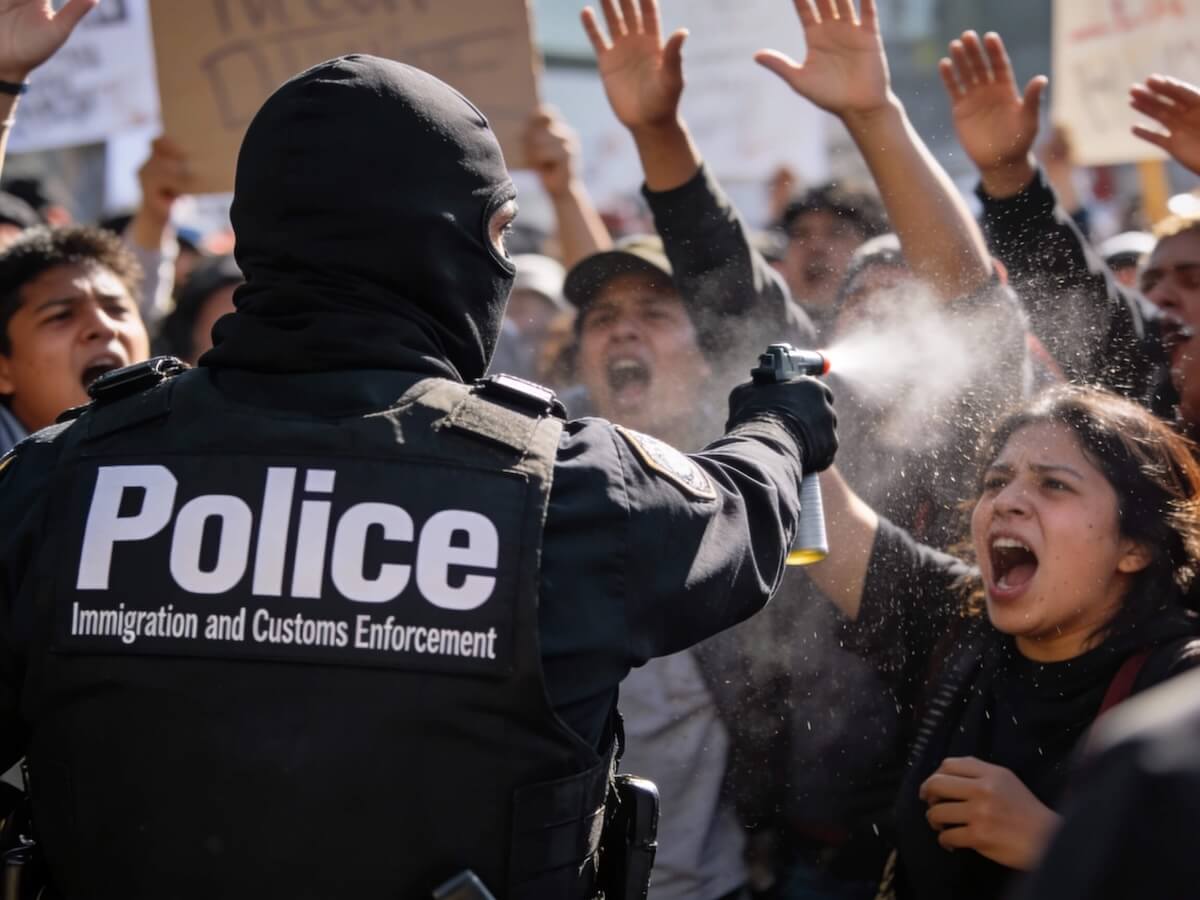
In recent years, Americans and Canadians alike have been confronted with images of U.S. immigration officers wearing vests emblazoned with the word “Police.” For many observers, the reaction has been visceral. Are these officers really police? Are they allowed to present themselves that way? And what does this mean for civil liberties, especially when immigration enforcement is often civil rather than criminal in nature?
The answers reveal a sharp and important contrast between the United States and Canada — one that goes to the heart of how each country understands state power, accountability, and democratic restraint.
ICE Agents Identifying as “Police” in the United States: Legal but Controversial
In the United States, immigration enforcement is carried out by U.S. Immigration and Customs Enforcement, commonly known as ICE. ICE is a federal agency within the Department of Homeland Security, and its officers are federally sworn law-enforcement officials. They are authorized to carry firearms, detain individuals, and make arrests in connection with immigration enforcement.
From a strictly legal perspective, this matters a great deal. Under U.S. law, ICE officers are not pretending to be law enforcement — they are law enforcement. Unlike in Canada, the word “police” is not a protected or tightly regulated title in the United States. It is treated largely as a descriptive term rather than a formal institutional designation.
American courts have repeatedly taken the view that what matters is whether an officer has lawful authority, not whether their uniform precisely reflects a particular branch of government. If an officer is legally empowered to enforce the law, identifying as “police” is generally permitted. This is why ICE agents, like members of other federal agencies participating in joint task forces, may legally wear uniforms marked “Police.”
In other words, the practice is lawful. But legality alone does not resolve the deeper concerns.
Authority Versus Perception: Why the Practice Raises Alarms
The controversy surrounding ICE’s use of “Police” is not about impersonation in a narrow legal sense. It is about perceived authority, and how that perception shapes behavior in moments of stress and fear.
For most people, especially those without legal training, the distinction between civil immigration enforcement and criminal policing is far from obvious. When someone wearing “Police” arrives at a door or conducts a stop, the assumption is that criminal law is in play and that refusal or hesitation may itself be a crime. In reality, many ICE encounters involve civil matters where individuals may have the right to decline entry, remain silent, or request legal counsel.
Critics argue that labeling immigration officers as “Police” effectively expands their power without changing the law. It increases compliance not through legal mandate, but through confusion. It blurs the line between local policing and federal immigration enforcement, undermining efforts by municipalities to maintain trust between police services and immigrant communities. And it makes it harder for individuals to understand — let alone assert — their rights in real time.
This is what civil liberties advocates mean when they warn about “policing by stealth.” The authority grows not because legislators voted for it, but because the optics quietly normalized it.
Immigration Enforcement in Canada: A Deliberately Different Model
Canada’s approach to immigration enforcement looks similar on the surface but operates on very different legal and cultural assumptions. Immigration and border enforcement here is carried out by the Canada Border Services Agency, or CBSA.
CBSA officers have significant powers. They enforce immigration and customs laws, they can detain and arrest individuals in defined circumstances, and they have been armed since 2007. They are considered peace officers for the purposes of carrying out their duties.
Yet despite these powers, CBSA officers are explicitly not police — and they do not identify themselves as such.
This is not an oversight or a cosmetic choice. It reflects a core principle of Canadian law.
Why the Word “Police” Is Restricted in Canada
In Canada, “Police” is not merely a descriptive label. It is a legally protected institutional title governed primarily by provincial Police Acts. While the specifics vary across provinces, the underlying rule is consistent: only legally constituted police services may present themselves as police.
This includes municipal police services, provincial police forces such as the Ontario Provincial Police or the Sûreté du Québec, and Canada’s federal police force, the Royal Canadian Mounted Police. These organizations are subject to defined governance structures, civilian oversight, and accountability mechanisms that go beyond individual officer conduct.
Agencies with enforcement powers but narrower mandates — including CBSA — are intentionally excluded from this category. They are expected to identify themselves accurately and precisely, so the public knows who is exercising authority and under what legal framework.
The objective is clarity. Canadians should not have to guess what kind of power is being exercised over them.
Civil Liberties Outcomes: Ambiguity Versus Clarity
These different approaches produce different civil liberties outcomes, even when enforcement powers appear similar on paper.
In the United States, the broad and flexible use of the word “police” has made it easier for authority to expand without explicit public debate. When immigration enforcement looks and feels like criminal policing, people are less likely to distinguish between the two, and less likely to assert their rights. Courts have generally focused on whether ICE has legal authority, not whether the presentation of that authority misleads the public.
In Canada, by contrast, institutional clarity acts as a brake on overreach. When enforcement officers are clearly identified, it becomes easier to understand the limits of their mandate and to challenge actions that exceed it. Accountability flows more directly because authority is not diffused across ambiguous labels.
This does not mean Canada is immune to abuse or excessive enforcement. But it does mean that our legal system is designed to make such abuses easier to see, name, and contest.
Why This Matters Now for Canadians
Canada exists in the gravitational field of the United States. American political, legal, and security practices exert constant pressure northward, especially during periods of instability, migration, or geopolitical tension.
History shows that democratic erosion rarely announces itself loudly. It arrives through small shifts in language, through “temporary” measures that become permanent, and through borrowed practices adopted in the name of efficiency or security.
If Canadians become indifferent to how authority is labeled and exercised, we risk importing not just U.S. enforcement tactics, but U.S. assumptions about power — assumptions that place operational convenience ahead of public understanding and consent.
Standing Guard: A Call to Canadians
Canada’s democratic safeguards did not emerge by accident. They were built deliberately, shaped by hard lessons about state power, accountability, and restraint. The distinction between police and other enforcement officers is one of those safeguards.
To stand guard today means paying attention before lines blur. It means defending the principle that authority must be clearly named, narrowly defined, and publicly accountable. It means resisting the quiet normalization of practices that expand state power without democratic consent.
As the United States moves toward more aggressive, more opaque enforcement models — often framed in the language of strength and security — Canadians must decide what kind of country we intend to be. Sovereignty is not only about borders. It is about values, institutions, and the courage to say no when pressure mounts.
Words on a uniform may seem small. But history teaches us that when those words change, the balance between freedom and power often changes with them.
Standing with Canada means standing guard — now, before the lines are redrawn for us.



My favourite sentence in this piece: “It [to stand guard] means resisting the quiet normalization of practices that expand state power without democratic consent.” Thanks for writing this essay.