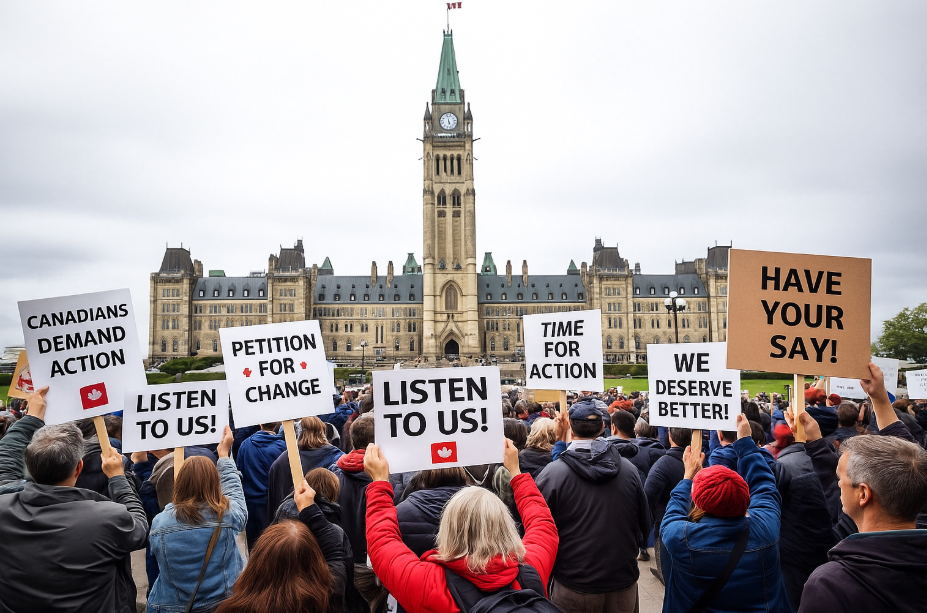

Most Canadians are unaware that they have the right to submit petitions directly to the House of Commons—a mechanism that ensures their exact words enter the parliamentary record. It is one of the few tools available to citizens that bypasses political intermediaries and speaks in an unfiltered way to Parliament. Clear instructions for doing so are publicly available here. We recently followed that process by drafting the following petition, obtained signatures at several Kingston public events and submitted it to our MP’s constituency office in compliance with those instructions.
We chose this route because of a growing concern that, at a time when Canadians must stand firmly united to resist takeover by the Trump regime, Canada’s political culture continues to practice corrosive partisanship. More than ever before, our nation needs a Parliament that exemplifies rationality and unified national resolve. Instead, too many of our elected representatives appear consumed by tactical point-scoring and partisan skirmishes that do little to address their country’s real challenges.
Our petition asked MPs to reduce the level of toxic partisanship in the House and to recommit to a standard of conduct that reflects the seriousness of their responsibilities. We gathered signatures at several public events in Kingston and formally submitted the petition through our MP’s constituency office, in full compliance with parliamentary procedure.
PETITION TO THE HOUSE OF COMMONS IN PARLIAMENT ASSEMBLED
We, the undersigned citizens and residents of Canada draw the attention of the House of Commons to our following concerns regarding our future as a nation:
THAT US President Donald Trump has on multiple occasions publicly declared his intention to make Canada the 51st State of the USA while never acknowledging Canadians’ legal and moral right of self-determination;
THAT many informed political observers have pointed out the extreme unlikelihood of the dominant Republicans ever agreeing to expand the current US electorate with 30 million new voters holding world views which are very different from their own;
THAT President Trump’s sole viable option for achieving his stated objective would therefore be military annexation, relegating Canada to the status of a US territory and leaving Canadians disenfranchised, with potentially no civil rights and all decisions affecting our lives and futures made in Washington in service of perceived US interests;
AND THAT the divisive, increasingly toxic partisanship which has been manifesting in the House of Commons in recent years threatens to undermine the national solidarity and unity which we will need to deter any such hostile takeover of our country.
THEREFORE, your petitioners call upon Members of Parliament of all parties to immediately forswear and discourage any and all further divisive partisanship, coming together collegially and prioritizing the national interest in the conduct of our nation’s business and external relations.
RESPONSE by the President of the King’s Privy Council for Canada and Minister responsible for Canada-U.S. Trade, Intergovernmental Affairs, Internal Trade and One Canadian Economy
Signed by Tim Louis
On April 28, 2025, over 19.6 million Canadian citizens exercised their Charter right to vote, and elected 343 Members of Parliament, from five different political parties, to represent them in the House of Commons.
In our free and democratic society, and in a country as large and diverse as Canada, it is inevitable that there will be differences of opinion, divergent views on government policy, and agreement or disagreement on questions of public importance. That is the nature of democracy, which is always a work in progress.
For our part, the Government is responding to the challenges that Canada and Canadians face in a changing global environment. We are taking action to diversify our economy, develop nation-building infrastructure, and build homes for Canadians. We will protect what matters most: our people, our communities and our sovereignty.
Doing these things means making decisions. There will be agreement on some matters, and there will be disagreement on others. Each Member of Parliament has their own views as to what is best for the communities they represent. But whether we agree or disagree, as a Government we will always strive to do so with respect for one another as Canadians and as Parliamentarians.
Over the past decades, the concentration of power in the Prime Minister’s Office and the doctrine of strict party discipline have fundamentally reshaped our system. Neither that concentration nor that doctrine is in any way supported by our Constitution. The result is a Parliament where MPs no longer serve as principled, thoughtful representatives of their constituents’ views and needs. Rather, they have allowed themselves to become mere mouthpieces for their respective parties’ political messaging. Those who attempt to speak or vote according to their constituents’ interests or their own moral judgement frequently face consequences, including expulsion, diminished roles or barriers to re-nomination.
Our petition called for a shift away from this unhealthy dynamic. It asked parliamentarians to take responsibility for the tone of national debate and to refuse to participate in the escalating cycle of division. The response we received indicates that the governing party is unwilling to make such a move unilaterally. Meaningful improvement would require all parties to agree to restore long-standing norms of respectful discourse and independent judgement.



0 Comments