
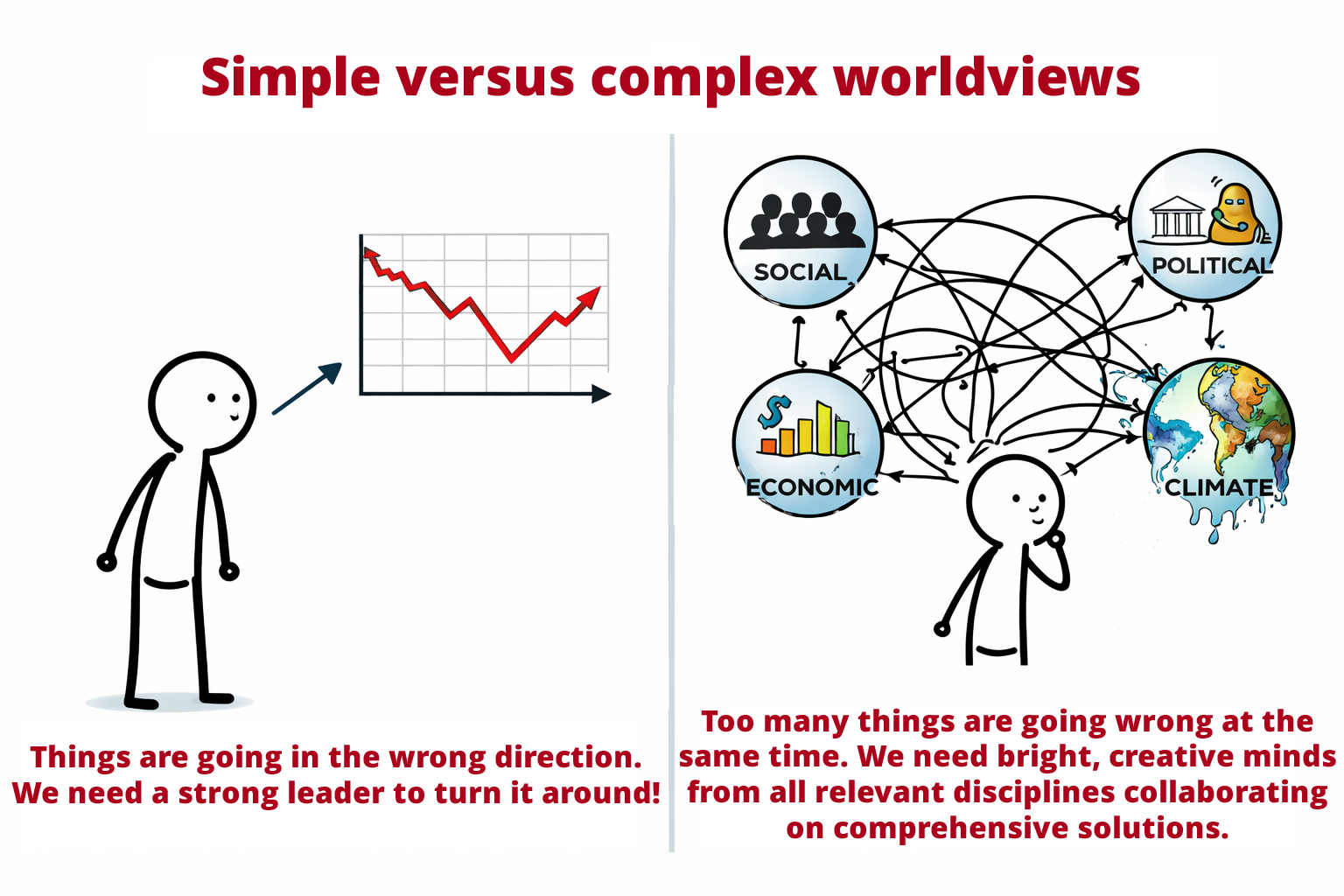

The adage “For every complex problem there is a solution that is clear, simple, and wrong” is attributed to the 1920’s American journalist and satirist H. L. Mencken. That’s a profound maxim which I’ve long taken to heart and which has served me well in my life. Scientific literacy very much includes the realization that every aspect of living things, and indeed of the universe itself, is inherently complex. Fortunately, our human brains have the capacity to weave together relevant aspects of that otherwise-overwhelming complexity into the manageable strategies and decisions which enable us to survive and thrive.
Increasingly, the innovative technologies which now underlie our economies and way of life are mostly based on underlying complexities which are fully understood only by researchers and other experts in the corporations which have brought them to market. Yet, over the past two decades, the political sphere has gone in the opposite direction, with national and regional politics and public-sector decision-making increasingly concentrated on party leaders and their entourages who tend to favour simplistic messaging over well-thought-out evidence- and outcome-based planning and execution. The combination of an ever-more-complex world governed by ever-more-simplistic governments can only result in underperforming nations, provinces/states and economies.
Those self-defeating trends have most clearly manifested in the United States, where the experts in almost every field of knowledge have been denigrated, human rights and constitutional protections ignored, world-leading universities defunded and unaccountable thuggery by government agents embraced. With major governmental bodies such as the Departments of Justice, Homeland Security and Education, as well as the Centers for Disease Control headed by know-nothing crackpots, the expression “the inmates are running the asylum” has never been more apt.
As Canadians, we are far from immune to some of those symptoms. Witness our governments’ response to the COVID pandemic. Comparing two very similar developed countries, Canada and Australia, we experienced almost 50% more deaths per million population than our Australian counterparts. All of which suggests that something in excess of 25,000 Canadian deaths may have been avoidable. Previously in our history, there would have definitely been a Royal Commission investigating why all those people died and what lessons could be learned from bitter experience to better protect us from future pandemics. Now, however, neither federal nor provincial governments will touch such questions with a proverbial 10-foot pole. In fact, it has been almost 35 years since the last Royal Commission was started. Prior to that, our federal governments had averaged almost three Royal and other Commissions of Inquiry per year since Confederation. Why such a radical change in what had been an important element in our nation’s governance? The obvious implication is that it would be anathema to the unaccountable, behind-the-scenes political operatives now making the most of the decisions in leaders’ offices that they might ever be risk of being subpoenaed to testify publicly under oath.
That aside, Canadians’ constitutional rights are still by-and-large honoured by our governments and protected by the courts. Out-and-out corruption whereby wealthy individual and corporations can now openly buy political favours is largely unknown. Expertise is generally respected, as is academic freedom, which is enabling Canada to become the go-to North American destination for international scholars. Most of all, Canadians remain free to engage in intelligent, wide-ranging political and economic discussion without fear of retribution. One of the first signs of growing fascism, the fear-driven need to consistently lie to authority, is virtually absent here, as are culture warriors demanding that everyone pay lip service to their narrow ideologies. In short, Canadians remain free to devise and advocate for real solutions to the complex challenges facing ourselves, our children and our grandchildren. That freedom is well worth advocating and fighting for.




0 Comments