
The problem: instability caused by erratic politics
It is time that Canadians faced the very uncomfortable fact that the world has fundamentally changed in ways that undercut the relative personal security and predictability which most of us have taken for granted through much of our lifetimes. That hugely uncomfortable fact and its consequences were most clearly explained by our Prime Minister, Mark Carney, in his hard-hitting speech of January 20, 2026 to the World Economic Forum Annual Meeting at Davos, Switzerland. In that address, he quipped that “Middle powers must act together because if you are not at the table, you are on the menu”. His powerful words evoked a standing ovation.
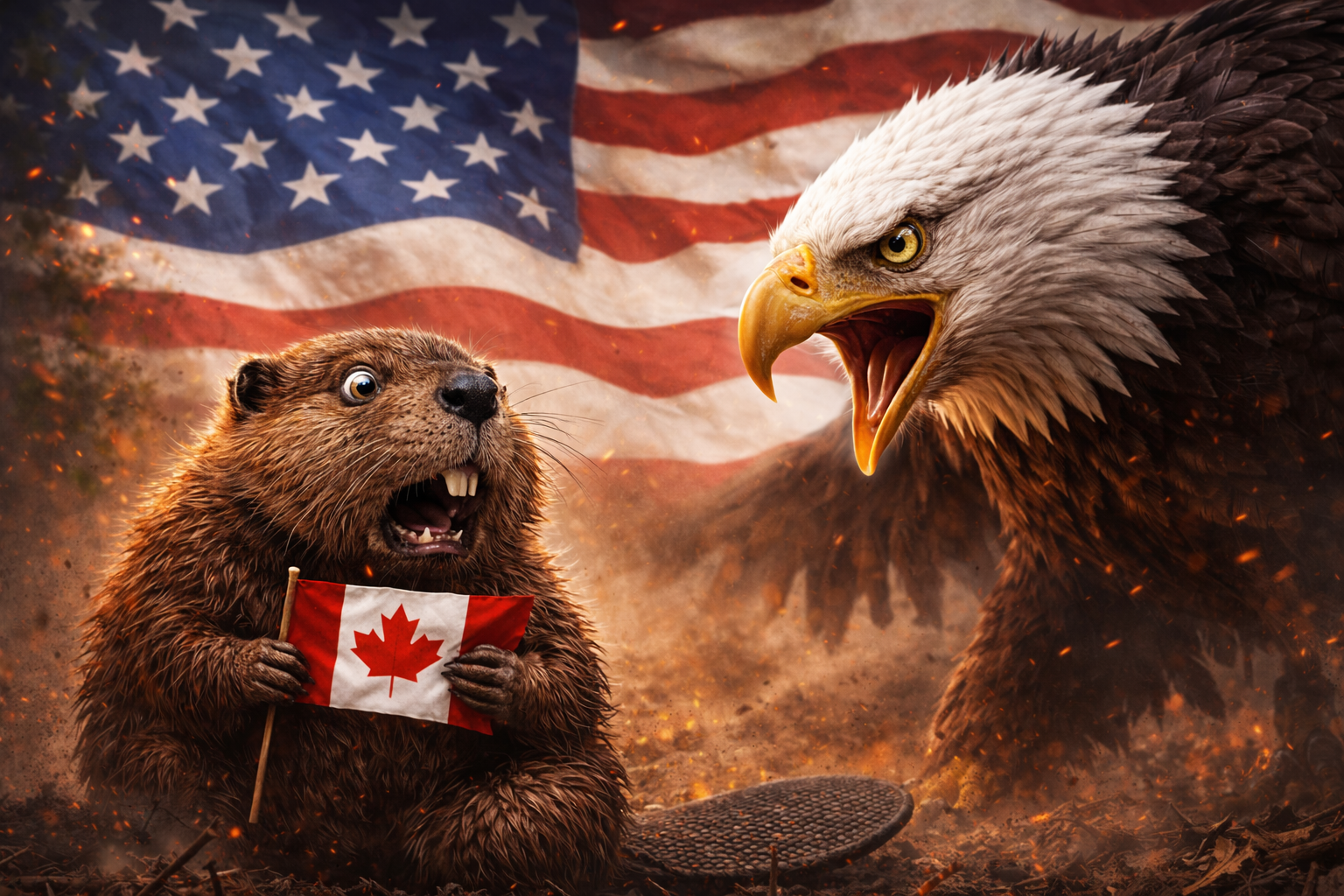
Prime Minister Carney’s proclamation to a global audience that silence is no longer a viable option is something in which Canadians should take pride — despite the fact that there will be consequences given that President Trump has made it crystal clear on multiple occasions that both Greenland and Canada are very much on his menu. Most recently, he posted a bizarre map image with both countries along with Venezuela depicted as being under the Stars and Stripes banner. His disturbing parallel post of himself taking possession of Greenland is more akin to the actions of a madman than those of the most powerful world leader.
How Trump views Canada and what that could mean for our future
In its November 2025 National Security Strategy, the Trump Administration reasserted the long-discarded 1823 Monroe Doctrine which had declared the entire Western Hemisphere off-limits to future European colonization and interference. This strategy — dubbed the “Donroe Doctrine” — actively asserts U.S. primacy through direct intervention and control within the hemisphere, including unilateral military action to force compliance and remove what the Administration may view as uncompliant governments. It focuses on securing U.S. interests, resources like Venezuelan oil, projecting American power and removing rival influences such as China, Russia, and Iran.
That projection can include using private-sector military contractors, economic sanctions, and political coercion, often to install pro-U.S. governments irrespective of the wishes of their people. As exemplified by the recent attack on Venezuela, it ignores the UN Charter and other international laws that prohibit the use or threat of force except pursuant to UN Security Council authorization or in self-defence against armed attacks. It also violates the US Constitution, which vests in Congress the sole responsibility for authorizing acts of war. Other attacks like recent bombings of Columbian fishing boats and the follow-up killing of survivors would undoubtedly be deemed war crimes were the perpetrators ever arraigned in a competent court of law.
Even more surprising, ordinary U.S. citizens have been deliberately shot and killed by thuggish, masked, machine-gun-carrying ICE agents in residential US neighbourhoods for the crime being present at constitutionally-protected protests against such incursions. A quick Google search yields many chilling YouTube videos showing levels of real-world federal government-sanctioned violence that would previously have been found only in dystopian science-fiction movies. While the Trump Administration claims such raids as essential to combat high levels of illegal residents, the underlying political motivation is obvious in that that those raids are primarily inflicted on cities and states which voted Democratic in the last election, and never in Republican states despite the fact that they have much higher rates of illegal immigrants. The agents committing what are in effect murders appear to have had no significant training in law enforcement and constitutional rights, and are essentially unaccountable since they are protected from standard post-mortem investigations. In a disturbingly fascist way, the victims are invariably deemed by everyone in the “chain of command” all the way up to the President to have been “terrorists”, without any substantiating evidence.
Why is this relevant to Canadians? Because the current dystopian US reality represents a preview of how our lives would change should Trump ever choose to fulfill his oft-stated desire to take over our nation, which would require a military takeover in the absence of any legal channel for doing so. As discussed in my prior posts on this subject, his calling us a “51st State” is entirely misleading. The term suggests that Canada would become a state like all the others, with full voting rights and constitutional protections (for what they are still worth). Simply put, the Republicans would never countenance adding some 30 million “flaming leftie” (from their perspective) voters to US elections, which would tip the balance to Democratic electoral victories. More likely, we would be a US territory with no voting or constitutional rights, leaders chosen by Washington to further American interests and our natural resources given away to the highest bidder. Essentially, Canadians would be reduced to living in a climate of helpless fear and increasing poverty.
It is worth noting that Trump has never once suggested that his acquisition of Canada, Greenland and Venezuela would require the consent of each country’s citizens. Democracy is obviously not relevant to the fulfillment of his “what’s mine is mine and what’s yours is mine” worldview.
How can we maintain our rights and freedoms while being true to our values?
I appreciate that this portrayal seems bleak and that many Canadians have come to tune out Trump news—deeming a U.S. invasion unthinkable or too disturbing to contemplate. Unfortunately, over the past year, almost every statement that begins with “Trump would never …” has been proven wrong. While he is too unpredictable for any meaningful estimate of whether or when such an invasion might happen, dismissing the possibility represents the proverbial “ostrich approach” of burying one’s head in the sand.
Trump envisions a world divided into three spheres of influence, each dominated by a superpower: the USA, Russia, and China. Prime Minister Carney has invited middle-power nations to collectively resist this “Three Bully World.” Canadians’ sole avenue for discouraging his designs on our country is to render any potential takeover too unprofitable to pursue. That means that Canadians must now actively demonstrate the will and ability to resist any U.S. invasion or moves to further dominate Canada economically. The prospects for a successful resistance movement are currently best depicted in the writings and video podcasts of former federal MP Charlie Angus.
Our federal government has already taken a good first step: the Department of National Defence (DND) has announced plans to build a volunteer reserve force of 300,000 or more Canadians. However, it would realistically take at least two or three years for such a reserve to be organized and for a sizeable fraction of the proposed number of volunteers to be recruited, trained and outfitted. Unfortunately, should an invasion occur, it would most likely occur within the next nine months, prior to the US midterm elections — assuming they are held given that Trump has twice “joked” that they might be cancelled. In the best of possible worlds, the midterms might cost him the near-dictatorial powers which he has assumed and curb US aggression toward Canada. In the meantime, resistance must come from everyday Canadians.
I had previously assumed that any such invasion would be over in a matter of weeks, with US troops and armoured vehicles zooming across the border and capturing Ottawa, and possibly some provincial capitals. In a recent post, Mr. Angus has made the interesting observation that, while the Canadian Forces could never stop a US incursion, actually holding Canada could be rendered more difficult. He argues that the US military has never fared well against resistance movements, that the 40,000 Canadian soldiers who served in Afghanistan brought back a thorough understanding of effective resistance strategies, that our vast geography would render suppression of such a movement far more difficult, and that even one percent of Canadians choosing to join a resistance would represent ten times the number of insurgents who had been available to the Taliban. Food for thought!
What I want to emphasize at this point is how ordinary Canadians could and should go about preparing for an insurgency in the event of an actual invasion. DND and the whole federal apparatus is simply too cumbersome to devise and implement workable solutions within the next year. Continency planning requires thinking about needs, resources and possible targets well in advance of any such continencies manifesting. Insurgency is inherently local, which suggests that widespread local planning is the only path to successfully thwarting a takeover in the near term. Local police authorities, military veterans, public utility personnel and other experts should all engage with concerned citizens in brainstorming what to do locally should the worst happen, as well as what precautionary steps should be taken now.
In parallel, all levels of government should consider the legal ramifications of how Canadians should respond in the event of a foreign invasion. In any successful occupation, the victors must co-opt local individuals as collaborators (often referred to as quislings) to maintain essential services and implement the occupiers’ directives. For example, would Canadian law deem police officers as traitors should they arrest citizens on the orders of the occupiers or pursuant to occupation directives? Does it matter whether they have been coerced, are acting for financial gain, or are motivated by offers of power and privilege? How about ordinary public servants reporting to the new masters? These are just a few examples of ethical dilemmas which should be debated in advance rather than waiting until they become life-or-death situations. Local town-hall meetings would be a good starting point.
Previous generations of Canadians had no choice but to deal with such difficult and dangerous matters. We are deeply indebted to them for their honorable and ultimately victorious resolve. Ideally, we won’t be thrust into such difficult situations but, should our turn come, may we do as well.

0 Comments