
The tale of two resistances
With Canada facing an uncertain but deeply troubling risk to its sovereignty from our previously allied U.S. neighbour—driven by increasingly authoritarian leadership—it behooves Canadians to seek inspiration from how ordinary citizens in other times and places have responded to threats posed by armed occupiers or unaccountable state power. Examining historical resistance movements and modern civil resistance strategies can help clarify what might be applicable should such a crisis unfold here.
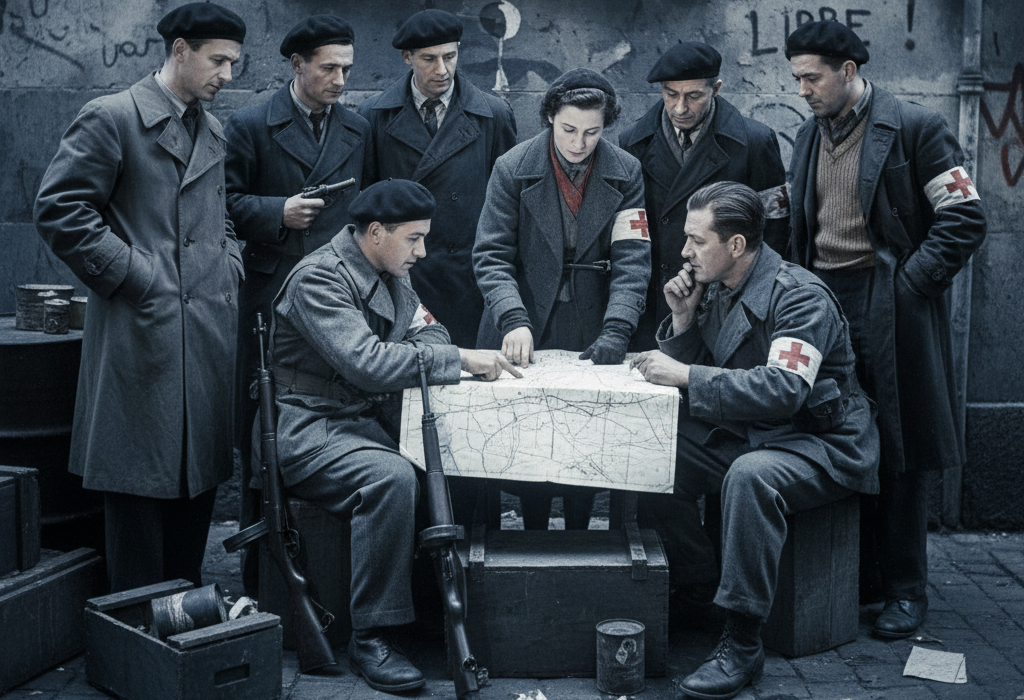
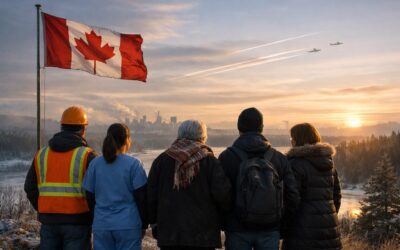
Two resistance movements are particularly instructive. The first, as illustrated in the above AI depiction, is the World War II French Resistance. The second, and more contemporary example of modern nonviolent resistance, is the remarkable way Minneapolis residents self-organized to oppose an aggressive federal security operation in their city.
The French Resistance and historical models of civilian resistance
The French Resistance was a diverse collection of clandestine citizen groups that emerged to oppose both the Nazi occupation of France and the collaborationist Vichy regime during World War II. Spurred by General Charles de Gaulle’s 1940 call to action, these men and women—including rural guerrilla fighters known as the Maquis—engaged in high-risk activities such as sabotaging German infrastructure, gathering military intelligence, and assisting the escape of Allied airmen.
Key figures such as Jean Moulin worked to unify these otherwise fragmented groups into a more coordinated force, eventually forming the French Forces of the Interior. This civilian resistance movement played a crucial role in supporting the Allied advance following the D-Day landings and contributed significantly to the liberation of Paris in August 1944.
Minneapolis and contemporary civil resistance in the United States
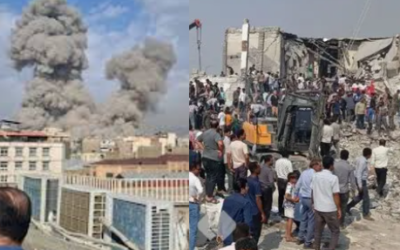
Minneapolis became the epicentre of a large-scale civil resistance movement following the arrival of more than 3,000 federal agents from Immigration and Customs Enforcement (ICE) and Customs and Border Protection (CBP) under what was described as “Operation Metro Surge.” Public opposition intensified after federal officers repeatedly shot civilians Renee Good and Alex Pretti and reportedly blocked paramedic attention which might have saved their lives. That prompted near-daily protests, including residents blocking unmarked federal vehicles and confronting masked agents operating in residential neighbourhoods.
Beyond street demonstrations, a decentralized “shadow network” emerged to alert communities to enforcement activity, assist those at risk, and document federal operations. This localized resistance expanded into a broader national protest movement, including coordinated work stoppages described by organizers as a “national shutdown.” City and state leaders—including Minneapolis Mayor Jacob Frey and Minnesota Governor Tim Walz—formally called for the withdrawal of federal forces, characterizing the operation as an unconstitutional federal overreach.
Different contexts require different resistance strategies
Different environments require different resistance strategies. As might be the case in a hypothetical U.S. occupation of Canada, the World War II French Resistance confronted a conventional military invasion by a neighbouring state following the rise of a fascist regime which enjoyed overwhelming military superiority. With their legitimate government dismantled and civil liberties eliminated, violent and clandestine resistance—often coordinated with Allied powers—was viewed by participants as one of the few remaining paths toward eventual liberation. In the absence of legal avenues for opposition, resistance groups formed locally, then coordinated nationally. Given the violent repression employed by the occupying forces, the Resistance employed both armed guerilla-style resistance and sabotage strategies, alongside widespread civilian non-cooperation with the imposed collaborationist Vichy regime.
The Minneapolis example differs in critical ways. Although ICE and CBP agents have operated with overwhelming force superiority, residents and protesters—unlike those directly targeted by enforcement actions—still theoretically retained constitutional protections for speech, assembly, and due process. Numerous circulating videos taken by witnessing local residents show those agents assaulting protesting residents, including the two incidents in which they clearly shot to kill US citizens Renee Good and Alex Patti. One particular video, seemingly taken from a body cam, shows a female attorney protecting her clients by verbally invoking their legal rights in order to repulse an ICE squad. Their disregard for those rights is painfully apparent in the video. Those agents clearly either did not know or had been given leave by their superiors to ignore those rights. The Trump administration has confirmed the agent training had been reduced from 5 months to 47 days.
What ultimately strengthened the Minneapolis resistance was the effective use of modern communications technology. Residents documented enforcement actions in real time, shared video evidence widely, and coordinated rapid, decentralized responses. This constant public scrutiny exposed repeated constitutional concerns and undermined official narratives, contributing to declining public support for the operation.
Lessons for a Canadian resistance movement
Lessons for a Canadian resistance must be drawn carefully, with full recognition that different conditions demand different responses. In Minneapolis, nonviolent resistance proved essential because the conflict is an internal one within a still-officially democratic country with constitutional protection for basic human rights. Organizers were conscious that violent escalation risked legitimizing further abuses. By publicizing documented violations and contradictions between official statements and observable facts, the movement steadily eroded public confidence in the Trump Administration’s immediate labelling of the victims as having been terrorists.
In a far more extreme scenario—such as a loss of Canadian sovereignty and consequent loss of all our civil rights—resistance strategies would necessarily differ. Nonviolent actors could play a vital role by documenting abuses, sharing evidence with international audiences, and maintaining moral legitimacy. Historical examples show that economic non-cooperation, strikes, and disruption of extractive systems have often been used to make occupations politically and financially unsustainable. Canada’s vast expanse of unpopulated territory could facilitate disrupting of the flow of coveted Canadian energy, mineral and other resources across the border. As with the French resistance, efforts would be needed to discourage cooperation with whatever puppet government that the occupying power might impose, painting such collaboration as treasonous.
Preparing for threats to Canadian sovereignty
Next steps for those who believe Canada should prepare for potential threats to national sovereignty might include the following:
- Think through a plan for what you and your family would do immediately upon learning of U.S. troops crossing the border;
- Prepare for that plan’s possible implementation by ensuring essential supplies and documentation are accessible;
- Connect with friends, neighbours, and community members who might collaborate in forming local resilience or resistance networks if needed;
- Seek insight from Canadian Forces veterans—particularly those with experience in counterinsurgency or civilian protection missions—about preparedness and lawful resistance;
- Take relevant training (e.g., first aid, wilderness survival, emergency communications, civic resistance education, Resistance School, No Kings online courses);
- Monitor the federal government’s stated plans to expand Canada’s Reserve Forces and consider volunteering once eligibility criteria are clarified.
Relevant links and further reading
- The Streets of Minneapolis (Bruce Springsteen’s powerful new protest song)
- Charlie Angus’ Resistance posts (Canada’s most prominent voice for resistance)
- Welcome to the American Winter (article in The Atlantic Monthly)
- What Should Americans Do Now (article in The Atlantic Monthly)
If you know of other articles or videos that should be added to this list, please share in the form of a comment to this post.

Andrew Coyle makes the excellent point in a Globe & Mail opinion piece published Jan. 30 ’26 that military invasion is less likely than other ways of overtaking Canada. He wrote: “…if you really want to imagine the kind of havoc they could create, suppose Canadian banks were to suddenly find themselves shut out of the U.S. dollar settlement system. Suppose our internet networks were to come under assault. Or our electricity grids. Some people in this country talk about cutting off exports of Canadian energy to the States, as a means of punishing them for actions we dislike. They forget that the U.S. has far greater ability to do the same to us. There has been much talk of what we need to do externally to give ourselves greater bargaining power – of the need to develop options, in trade, and allies, in defence and security matters. All well and good. But we need also to pay much more attention to strengthening our own internal resilience – our capacity to endure whatever the Trump administration might throw at us.That’s not only or even primarily about military capacity. That’s about capacity generally: state capacity, to be sure, but more broadly, societal capacity. The point of the measures described above, especially in the havoc-creating end of things, is to cause pain, to induce panic, to sow divisions and, ultimately, to force capitulation. Our exposure in this case is not only a function of our proximity to the U.S., but our own internal weaknesses.”
Thanks for your comment Berenice. I deeply respect the role Andrew Coyne plays in the mainstream media. He is willing to speak uncomfortable truths without pretending that demonstrably false or incoherent narratives deserve “equal weight” for the sake of balance.
When it comes to the risk of political or territorial aggression from the United States, certainty is impossible — particularly given the volatility and erratic behaviour of the current U.S. administration. But uncertainty should not be mistaken for safety. The threats are real, as seen in rhetoric aimed at Greenland, Mexico, and Panama. Concrete actions have already followed elsewhere, including Venezuela. Economic pressure and political interference are not hypothetical; they are active tools. What cannot be reliably predicted is how this interference might manifest at ground level — whether through funded agitators, large-scale financial support for radical separatist movements in Alberta, or covert or overt military posturing.
One thing is clear: fear is being deliberately weaponized, and it works. Our task is not to panic, but to prepare — to meet fear with resilience, resolve, and a confident belief in our democratic values and in one another as Canadians.
Joe, I agree with you — “our task is not to panic, but to prepare…” My point in citing Andrew Coyle was to encourage Ron to expand his list of recommendations under the heading “Preparing for threats to Canadian sovereignty” beyond the six that he offered, which all pertained to ways to prepare for, and respond to, US forces crossing the border. Canadians also need to prepare for other–possibly more likely–ways of losing our sovereignty. Perhaps that will be the subject of a future column by you or Ron? I hope so.
I also was also intending a “both/and” view regarding the threats against our sovereignty, so thanks for this suggestion. An additional article would indeed be helpful outlining some actions ordinary Canadians can take to resist the threat of economic, social and political aggression from this U.S. administration. Do you have any suggestions about what we could be doing, what you are currently doing, or what you have witnessed from others? We hope these articles are sparks for expanding the discussion. You can use this comment space to add comprehensive input to the conversation.
Your reasonable responses — basically, “what are you suggesting we do, and what are YOU doing?” — deserve thoughtful, well-founded answers. Which I don’t have right now. (Except to say I’m doing zero at the moment beyond a lot of reading while sitting on my couch. I hope to change this in the next few months.) I’ll be back in touch when I have better answers to offer. Let me just offer this as my starting point: Without unity from British Columbia to the Maritimes, little else can make a difference in the face of external threats. So I will be looking for ways to help reinforce or build that unity.
Berenice – I will take a stab at an article that considers what practical actions we can take to resist the economic, political and social threats to our sovereignty to add to what Ron has already addressed in his article. In writing I will incorporate your point about unity from coast to coast to coast. Thanks!
Good comments all. We definitely need to consider and plan counters to other potential initiatives aiming at undermining Canada’s integrity and sovereignty. As someone whose career involved high-stakes contingency planning, I’ve learned the importance of starting planning for the worst case threats even if they are less probable and especially if meaningful countermeasures would require significant time to plan and implement. Invasion happens to be just that kind of threat. We certainly need to consider the other possible threats, and will do so as time permits.