
The USA’s aggression toward Greenland
If you are a Globe and Mail subscriber, you will hopefully have read the September 8 Opinion page article titled “As the U.S. interferes in Greenland’s public debates, we could be next”. That thought had also occurred to me a few weeks ago when Denmark’s national broadcaster published allegations regarding a three-operative Trump team in Greenland running a clandestine operation to undermine Green’s sovereignty by recruiting and supporting pro-secession, pro-US activists. The fact that 85% of Greenlanders oppose being taken over by the US is apparently meaningless when the Great Leader in Washington wants their land. That happens to be very similar to the overwhelming percentage of Canadians who likewise abhor the thought of our country being absorbed by the rapidly emerging US fascist dictatorship.
Maine’s aggression toward Canada
Maine State Senator Joseph Martin’s early-August letter to Western Canadian provincial legislators urging their provinces to secede from Canada to join the United States strongly suggests that he was speaking for the Trump Administration as opposed to the best interests of his own constituents. Given that Maine is arguably the US State most economically dependent on Canadian trade and tourism, those constituents will pay the price of further insulting many Canadians, thereby stiffening their resolve to boycott Maine goods and services. His intervention can be viewed as escalation in an ongoing campaign to undermine Canada’s sovereignty, as well as an indication that access to our natural resources is a primary motivator.
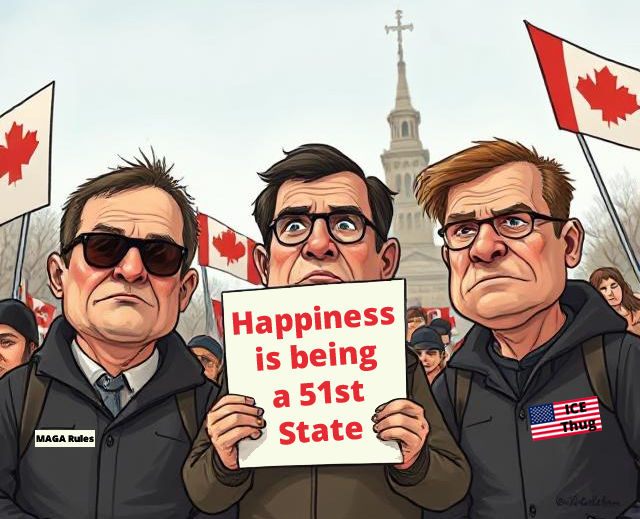
Alberta and Saskatchewan are the most likely initial targets for MAGA infiltrators and possibly even US intelligence agencies to be working behind the scenes to undermine Canada’s sovereignty, both because their provincial governments have a history of chafing at both Charter of Rights restrictions on their ability to freely implement their right-wing agendas as well as their general antipathy to recent federal governments. Much has been written over the past year on the urgent need for Canadian security agencies to better track and control such agents. Thus far, China, India, Russian, Iran and Pakistan have been viewed as the main offenders. While our federal government is unlikely to openly name the United States in that regard, the Trump Administration obviously constitutes our greatest risk and should therefore be Canada’s highest priority for monitoring by the responsible agencies.
The Clarity Act: Why it matters
I have previously written that our federal government should table companion legislation to the existing Clarity Act to provide guidance for both public servants and ordinary Canadians with respect to their rights and responsibilities in the event of a foreign invasion. That Act, passed in 2000 and upheld by a Supreme Court ruling, proved very successful at diffusing the Quebec sovereignty movement. The Clarity Act itself should be reviewed for its applicability to a foreign power seeking to entice individual provinces into seceding from Canada with a view to identifying possible amendments to address our current vulnerabilities, which could not have been imagined at the time.
While recent polls have reported that 85% of Canadians say they’re tired of hearing about Donald Trump, history has proven that burying one’s head in the proverbial sand in the face of a developing fascist dictatorship has always has disastrous consequences. What we need instead is new ideas and informed debate on what ordinary Canadians can do to reduce the risk of a Trump takeover of our beloved country, as well as more resolve to get behind those ideas. If you have any such ideas, please don’t keep them to yourself.



0 Comments